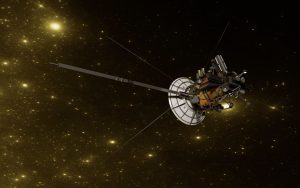
Voyager 1 spacecraft is making headlines as it nears a historic one light-day from Earth. This milestone offers unprecedented insights into the vastness of space and our place within it.
What is Voyager 1?
The Voyager 1 spacecraft, launched by NASA in 1977, represents a monumental achievement in space exploration. Designed to study the outer planets of our solar system, it has far surpassed its original mission goals and continues to send back valuable data from the depths of space.
As the first human-made object to enter interstellar space, Voyager 1 has traveled over 14 billion miles from Earth. Its primary mission was to explore Jupiter and Saturn, but its journey has taken it beyond these gas giants, providing insights into the heliosphere and the boundary where our solar system meets interstellar space.
The spacecraft is equipped with a variety of scientific instruments that allow it to measure magnetic fields, cosmic rays, and solar wind. These instruments have helped scientists gain a deeper understanding of the conditions beyond the influence of our Sun.
In recent news, Voyager 1 has reached a significant milestone, nearing one light-day away from Earth. This distance highlights the incredible journey it has undertaken, and the data it continues to relay back to Earth is invaluable for researchers studying the cosmos.
As Voyager 1 moves further into interstellar space, it remains a beacon of human ingenuity and curiosity, pushing the boundaries of what we know about our universe.
Significance of One Light-Day
The Voyager 1 spacecraft, launched in 1977, continues to provide invaluable data as it journeys through interstellar space. Reaching a distance of one light-day from Earth marks a significant milestone in its mission, showcasing the vastness of our solar system and the remarkable achievements of human engineering.
This distance is noteworthy for several reasons:
- Scientific Research: Voyager 1 is equipped with instruments that gather data on cosmic rays, magnetic fields, and plasma waves. This information enhances our understanding of the heliosphere and the boundary of our solar system.
- Technological Achievement: The ability to communicate with a spacecraft over such immense distances demonstrates the advancements in technology and engineering that have been made over the past few decades.
- Public Interest: Milestones like this ignite public interest in space exploration and science, encouraging future generations to pursue careers in STEM fields.
- Interstellar Exploration: The distance of one light-day highlights the challenges and opportunities that lie ahead for deep space missions, paving the way for future explorations beyond our solar system.
As Voyager 1 continues its journey, the insights gained from this historic moment will contribute significantly to our understanding of the cosmos.
Recent Discoveries from Voyager 1
The Voyager 1 spacecraft continues to provide groundbreaking insights as it approaches one light-day from Earth. Recent discoveries have expanded our understanding of the interstellar medium and the environment beyond our solar system.
Among the most significant findings are:
- Cosmic Ray Measurements: Voyager 1 has detected increased levels of cosmic rays. This data helps scientists understand the boundary between our solar system and interstellar space.
- Magnetic Field Observations: The spacecraft has provided new information about the magnetic field in the heliosphere, revealing how it interacts with interstellar magnetic fields.
- Plasma Wave Signatures: Voyager 1 has recorded unique plasma wave signatures that suggest the presence of a more complex structure in the interstellar medium than previously thought.
These discoveries contribute to a larger narrative about the nature of our galaxy. The data from Voyager 1 is particularly valuable as it is the first human-made object to enter interstellar space, allowing scientists to draw parallels between its findings and theoretical models of the cosmos.
As the Voyager 1 spacecraft continues its journey, scientists eagerly await further revelations that could reshape our understanding of the universe.
How Voyager 1 Communicates with Earth
The Voyager 1 spacecraft, launched by NASA in 1977, communicates with Earth using a sophisticated system that relies on radio waves. This communication is essential for receiving scientific data and sending commands to the distant probe. Due to its current distance of nearly one light-day away, the process of sending and receiving signals is notably delayed.
To maintain contact, Voyager 1 utilizes a high-gain antenna to transmit information back to Earth. The spacecraft sends data at a rate of approximately 160 bits per second, which may seem slow by today’s standards, but is sufficient for the transmission of scientific information over vast distances.
Each signal transmitted from Voyager 1 takes about 17 hours to reach Earth, meaning that any command sent from mission control at NASA’s Jet Propulsion Laboratory requires patience. Similarly, commands sent to the spacecraft can take another 17 hours to be executed. This remarkable delay highlights the challenges faced by mission control when interacting with the Voyager 1 spacecraft.
Despite this delay, the data received from Voyager 1 offers invaluable insights into the outer reaches of our solar system. The information helps scientists better understand cosmic phenomena and the interstellar medium, reinforcing the importance of maintaining this communication link as the spacecraft continues its historic journey.
Future of Voyager 1 Mission
The future of the Voyager 1 spacecraft holds immense intrigue as it continues its journey through interstellar space. Despite being over 14 billion miles from Earth, Voyager 1 remains a beacon of scientific discovery and human ingenuity. As it approaches the milestone of one light-day away from our planet, researchers are eager to analyze the data transmitted back, which may provide crucial insights into the outer limits of the solar system.
Scientists anticipate that the information gathered by Voyager 1 will deepen our understanding of cosmic phenomena and the environment beyond our solar system. Key areas of focus for future research include:
- Interstellar Medium: Studying the particles and magnetic fields present in the space between stars.
- Cosmic Rays: Analyzing the high-energy particles that enter the solar system and their behavior in interstellar space.
- Plasma Waves: Investigating the interactions of plasma waves with the surrounding space environment.
As the Voyager 1 spacecraft continues its historic mission, scientists remain hopeful that it will unveil new mysteries of the universe. The ongoing data collection and analysis will not only enhance our knowledge but also inspire future generations to explore the cosmos further.
Challenges Faced by Voyager 1
The Voyager 1 spacecraft, launched in 1977, has encountered numerous challenges during its journey through the vastness of space. Despite its impressive longevity, these obstacles have tested the limits of its technology and operational capabilities.
- Distance and Communication Delays: As Voyager 1 moves further from Earth, the time it takes for signals to travel back and forth increases. At a distance of one light-day, communications can take approximately 48 minutes, making real-time responses impossible.
- Power Supply Concerns: The spacecraft relies on radioisotope thermoelectric generators (RTGs) for power. Over time, the output of these generators decreases, posing a risk to the instruments onboard. Engineers continuously monitor power consumption to ensure essential systems remain operational.
- Cosmic Radiation: Voyager 1 is exposed to high levels of cosmic radiation, which can interfere with its instruments and onboard systems. Protective measures and redundancy in design help mitigate these risks.
- Temperature Extremes: Operating in the cold vacuum of space, Voyager 1 must withstand extreme temperatures. The spacecraft’s systems are designed to function within a limited range, making thermal insulation and heating elements critical.
These challenges highlight the resilience of the Voyager 1 spacecraft and the ingenuity of the teams working to keep it operational, offering invaluable insights as it continues its historic journey.
Implications for Space Exploration
The Voyager 1 spacecraft has opened new avenues for understanding the cosmos, particularly as it approaches the historic milestone of one light-day from Earth. This distance, equating to approximately 93 million miles, is not only a testament to human ingenuity but also a critical point for future space exploration.
As Voyager 1 continues to transmit data, scientists are gaining insights that could revolutionize our understanding of the outer solar system. These findings have several implications for future missions:
- Technological Advancements: The spacecraft’s long-lasting power systems and communication technologies may inform the design of next-generation spacecraft.
- Interstellar Research: Voyager 1’s journey provides a unique opportunity to study interstellar space, offering clues about cosmic rays and magnetic fields beyond our solar system.
- Expanded Research Missions: The data collected could influence the selection of targets for future missions, perhaps guiding spacecraft towards unexplored celestial bodies.
Moreover, the Voyager 1 spacecraft serves as a symbol of human curiosity and determination. Its ongoing mission not only enhances our scientific knowledge but also inspires future generations of explorers to push the boundaries of what is possible in space exploration.
The Voyager 1 spacecraft continues to send back invaluable data as it travels through interstellar space. Scientists are eagerly analyzing the findings from the Voyager 1 spacecraft to deepen our understanding of the cosmos.
Sources
BGMI 4.7 Update Release: What You Need to Know Now · Raw Cashew Exports Ban: A Smart Move for Local Processors · Oppo Reno17 Series: Best Display and Camera Features Revealed